
News
National Network of Telework in the Interior extended to 88 municipalities and open to civil servants

National Network of Telework in the Interior extended to 88 municipalities and open to civil servants
"Teleworking in the Interior. Local Life, Global Work"
The National Network of Teleworking or Coworking Spaces in the Interior entered its 2nd phase, with the expansion of the number of municipalities where these spaces will be available and with the opening of doors to workers with a public employment relationship, whose ordinance defining the amount of financial compensation has already been published in the Diário da República.
The measure to extend access to civil servants, without any additional costs for the bodies or services to which they belong, is part of the programme of incentives for the establishment of State workers in the Interior, provided for in Decree-Law No 40/2020 of 17 July 2020. At the same time, it optimizes and extends the use and functionality of this National Network, which also integrates a total of 88 municipalities.
The Teleworking and Coworking Spaces are provided by the municipalities, duly equipped with computers, printers and Internet access, and are divided into areas of different typologies that include private areas for video calls, meeting areas and places for presentations or training actions.
The Municipalities are responsible for the dissemination of the Spaces through the respective pages and social networks, allowing virtual visits by any interested parties, as well as all information regarding the characteristics of the space, conditions of use, annual calendar, hours of use and associated cost.
According to the ordinance that determines the value of the cash compensation of the Incentive Program for the Fixation of State Workers in the Interior, workers with public employment ties of the general careers that integrate this program will receive a cash compensation of 4.77 € per day, which corresponds to the doubling of the meal allowance. This incentive is due for as long as the working conditions that led to its award persist and for a maximum of three years.
The Ordinance operationalizes Decree-Law No. 40/2020, which defines the allocation of incentives to workers with a public employment relationship integrated in general careers, of a pecuniary and non-pecuniary nature, in situations of change or temporary change of workplace to a geographical area of low density, as established in Ordinance No. 208/2017, of 13 July.
The Government also launched, in August 2020, the Interior Employment MAIS program, which allocates an initial support of up to 4,827 euros for workers who decide to move to the Interior territories. To date, 460 applications have been submitted, covering a total of more than 820 people (including applicants and their household members).
Applications for this programme remain open at IEFP and are aimed at unemployed or employed workers looking for a new job. Job creation is also covered. Most of the processes supported are from people who have moved from the Lisbon region to the Centro region (23% of the total) and 28% of the approved applications are from people who have created their own job.
Through the Regional Coordination and Development Commissions (CCDR), the Government is committed to supporting the hiring and mobility of workers and to contributing to the physical adaptation of Teleworking Spaces, as well as the acquisition of furniture and IT equipment.
By contributing to the reduction of geographical asymmetries and the democratization of professional opportunities, teleworking and coworking are particularly important for the interior territories.
The National Network of Teleworking and Coworking Spaces, created by the governmental areas of Territorial Cohesion and Labour, Solidarity and Social Security, is part of the Economic and Social Stabilisation Program (PEES). It contributes to the fixation and attraction of people and companies, decreases the need for travel and the consequent carbon footprint, and improves the quality of life of the populations of the Interior, promoting the reconciliation of work and family life. It is also aligned with the objectives of the Interior Valorization Program.
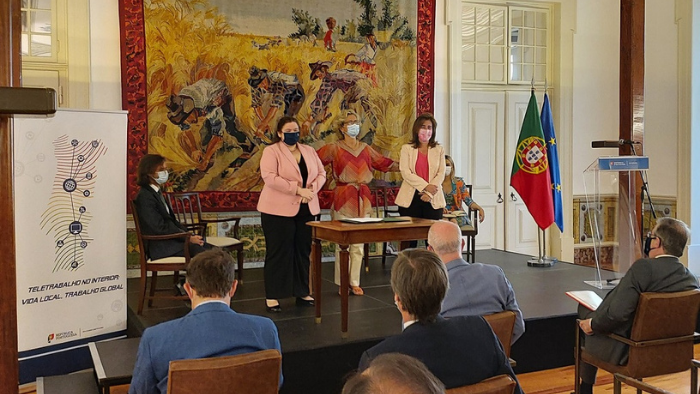
The signing of the MMEAP Accession Protocols and Cooperation Agreements with 31 new municipalities took place this Wednesday in Lisbon, with the presence of the Ministers of State Modernisation and Public Administration, Labour, Solidarity and Social Security and Territorial Cohesion.
List of 31 new Municipalities joining the Telework in the Interior Network. Local Life, Global Work”
North: Baião, Celorico de Basto
Centre: Oleiros, Góis, Penacova, Tábua, Vila Nova de Poiares, Guarda, Sabugal, Pinhel, Sátão, São Pedro do Sul
Alentejo: Odemira, Serpa, Vidigueira, Chamusca, Coruche, Castelo de Vide, Avis, Crato, Elvas, Fronteira, Nisa, Borba, Moura, Gavião, Viana do Alentejo, Castro Verde
Algarve: Lagos, Aljezur, Vila do Bispo
List of municipalities that were already part of the Telework in the Interior Network. Local Life, Global Work”
Northern Region: Amares, Arcos de Valdevez, Bragança Cinfães, Macedo de Cavaleiros, Melgaço, Miranda do Douro, Mirandela, Monção, Mondim de Basto, Paredes de Coura, Terras de Bouro, Valpaços, Vila Flor, Vila Nova de Cerveira, Vila Pouca de Aguiar, Vila Verde, Vimioso
Centre: Abrantes, Aguiar da Beira, Arganil, Carregal do Sal, Castelo Branco, Condeixa-a Nova, Covilhã, Figueira de Castelo Rodrigo, Fundão, Idanha-a-Nova, Lousã, Mação, Miranda do Corvo, Oliveira do Hospital, Ourém, Pampilhosa da Serra, Penamacor, Penela, Proença-a-Nova, Santa Comba Dão, Sever do Vouga, Soure, Vila de Rei, Vila Nova da Barquinha, Vouzela
Alentejo: Alter do Chão, Alvito, New Sales
Algarve: Albufeira, Alcoutim, Castro Marim, Faro, Loulé, Monchique, Olhão, Portimão, São Brás de Alportel ,Silves, Tavira
Source: Government Portal